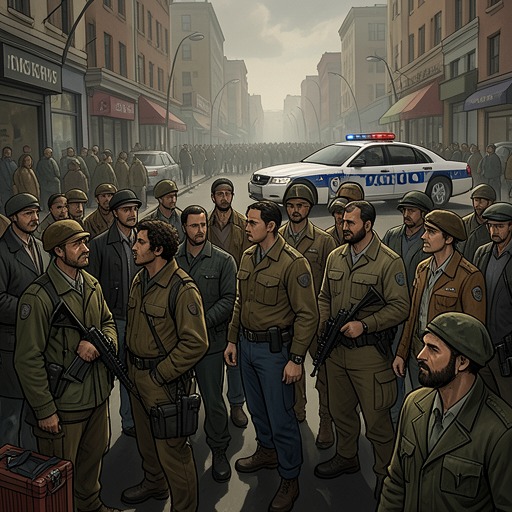
Coy Harlingen’s undercover status and release
Inherent ViceCoy Harlingen’s undercover status and release trace the cost of converting a family man into an informant: he disappears from his former life, works for overlapping antisubversive interests, and eventually recognizes that the assignment has taken him away from the people he misses. His return to his family and formal removal from the payroll mark a genuine change in his circumstances, but not an erasure of the separation that produced it.
Identity and Recruitment
Coy is a saxophone player and the father of an only daughter, Amethyst Harlingen. His undercover work reaches across different antisubversive organizations, including the Los Angeles Police Department, and leaves him with little freedom to resume his old life. When Doc Sportello raises Coy’s case with Crocker Fenway, he presents Coy as someone who has come to believe he made the wrong career choice: the work cost him both his family and his freedom. Doc’s appeal links Coy’s situation to Fenway’s own family life, emphasizing that Coy, like Fenway, has a daughter.
The earlier federal interest in Doc’s contact with Tariq Khalil shows how Coy’s covert life sits within a wider contest over information. Federal agents question Doc about Tariq and the chronology surrounding a prison acquaintance’s death and Mickey Wolfmann’s disappearance; they also ask about two Kahuna Airlines employees. Doc suspects that an explanation involving a political kidnapping could serve as a cover story, and the agents’ nervous exchange does not settle what they know. In this atmosphere, Coy’s hidden work is not an isolated deception but part of a world where official accounts, surveillance, and concealed objectives overlap.
The Work and Its Hidden Chain of Command
Coy comes to understand that the people who recruited him are themselves subject to a higher level of power. His handlers label him an “addictive personality” and treat commitment to informing as something he might find as difficult to quit as heroin. They send him among university, community-college, and high-school campuses to infiltrate antiwar, antidraft, and anticapitalist groups. The assignments make political surveillance his occupation while deepening his distance from his family.
The networks around this work are not confined to one organization. Doc tells Fenway that Coy has worked undercover for different antisubversive outfits, including the Los Angeles Police Department, and that Vigilant California is another obstacle to his exit. Fenway describes Vigilant California as useful in the street but limited in political judgment, while recognizing that its leaders may not want Coy to reveal confidential information. Doc believes he can deal with the police but remains concerned about the organization and whoever directs it. The distinction matters: leaving one employer does not by itself settle the risks posed by the others.
Recognition and the Attempt to Leave
Coy’s turning point comes during surveillance in Westwood. While following members of the Bong Users’ Revolutionary Brigades near UCLA, he sees a little girl about Amethyst’s age excitedly calling her mother’s attention to books in a bookstore window. The child’s presence forces his abandoned family back into view. For the first time since joining Vigilant California, he thinks about what he has done and about the future of the people he has helped target.
The recognition is both personal and political. Coy sees his faked death as a karmic error, understands that people he helps set up may face real death, and realizes how desperately he misses Hope Harlingen and Amethyst. He wants his old life back, but he has no resources, sympathy, or support to make that return straightforward. His subsequent conversation with Doc reflects the habits of an informant: Coy observes that people often ask questions when they already know the answer and want to hear it from someone else. Rather than spell out a solution, he directs Doc to speak with Shasta Fay Hepworth, leaving the next step to someone outside the institutions that have controlled him.
Release and Return
Coy’s return becomes visible when Hope tells Doc that he is alive and back. The news unsettles her; after being awake and overwhelmed for a prolonged stretch, she does not know what to believe. At a concert, however, Coy’s music gives her a concrete point of contact with the man who has returned. She remembers him lifting a baritone saxophone, placing the microphone into its bell, and playing forcefully. The performance does not resolve the history of his absence, but it lets Hope respond to him as a musician and as someone present again.
Coy later tells Doc that he is officially off everybody’s payroll; Burke Stodger has informed him in person. The declaration marks a practical end to the undercover arrangement, distinct from the earlier moment when Coy merely wanted out. He asks whether Doc attended the concert, mentions long solos on “Steamer Lane” and “Hair Ball” and a Dick Dale salute, and hears that his daughter enjoyed herself. When Doc says that Coy saved his own life and now has to live it, Coy falls silent before Doc ends the call. The exchange gives his release its measure: the work has stopped, but the life it interrupted must still be lived, beginning with the family and music to which he has returned.